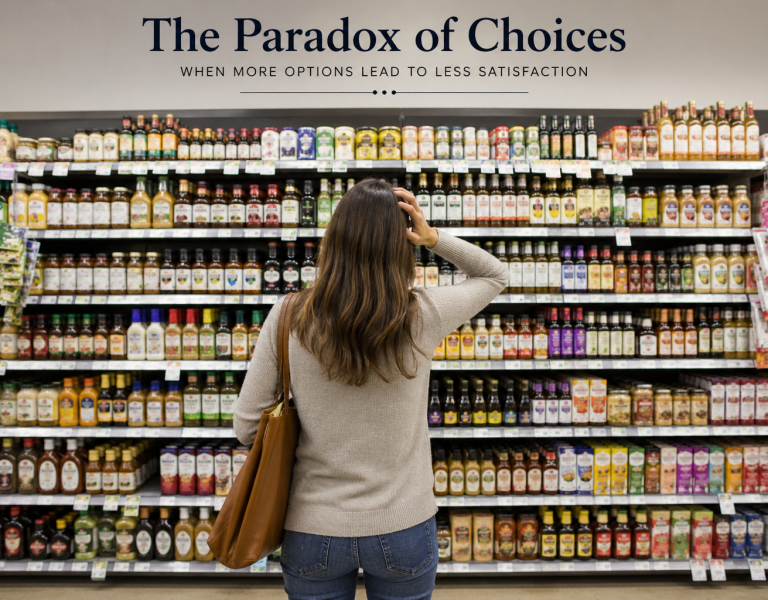
Picture this: You walk into a grocery store looking for jam. Instead of the three or four varieties you expected, you're confronted with 24 different options. Strawberry, raspberry, blueberry, mixed berry, organic, sugar-free, artisanal, imported... The shelves blur together. Ten minutes later, you walk out empty-handed, overwhelmed and strangely exhausted. This isn't just about jam. This is about one of the most counterintuitive findings in modern psychology: more choice can actually make us less happy. The Jam Study That Changed Everything In 2000, psychologists Sheena Iyengar and Mark Lepper conducted what would become one of the most famous experiments in behavioral science. They set up a tasting booth in a California grocery store, alternating between displaying 24 varieties of jam and just 6 varieties. The results were striking. While the larger display attracted more attention (60% of shoppers stopped to look versus 40% for the smaller display), the smaller selection led to dramatically more purchases. Only 3% of people who
saw 24 jams actually bought one, compared to 30% who saw just 6 options. Ten times more people made a purchase when presented with fewer choices. Why Too Many Options Backfire Our brains didn't evolve to handle the sheer volume of decisions modern life throws at us. Research suggests several reasons why excessive choice becomes paralyzing: Decision fatigue sets in when we're forced to make too many choices. Each decision depletes our mental energy, leaving us less capable of making good choices later. This is why successful people like Steve Jobs and Barack Obama minimized daily decisions by wearing the same outfits—they were preserving cognitive resources for more important choices. Opportunity cost anxiety increases with more options. When you choose one thing, you're simultaneously choosing not to have everything else. With 24 jam options, selecting strawberry means forgoing 23 other potentially better choices. This creates a nagging sense that you might be missing out. Maximizers suffer more than satisficers. Psychologist…